
Know When Your Equipment
Is Working with PTO
(Power Take Off)
Work trucks and tractors spend plenty of time on the move, but the money is made when they stop and the equipment goes to work. Every time a dump bed raises, a boom extends, a mixer drum turns, a tanker pumps off, a tractor runs a baler, or a winch pulls, that’s a job. The question is whether it’s a job you know about.
Power Take Off (PTO) alerts answers that question. With auxiliary inputs wired to the PTO, every time your equipment is engaged gets recorded with the time, the vehicle, and the location. That means every job can be matched to your work orders, and anything that doesn’t match stands out.
What is Power Take Off?
PTO stands for power take-off. It’s the part of the drivetrain that redirects engine power away from the wheels and into the truck’s working equipment. On most trucks, the PTO drives a hydraulic pump, and that hydraulic pressure is what does the heavy lifting.
PTOs show up on far more vehicles and machines than most people realize. Here are some of the most common examples:
That’s only a sample.
If a piece of your equipment is powered by a PTO or turned on with a switch, there’s a good chance it can be monitored the same way. Call 800-578-1809 and we’ll talk through your setup. In other words, if the PTO is on, the machine is working. Operators typically engage it with a switch in the cab when they arrive at a site and turn it off before driving away. That makes the PTO one of the most reliable signals you can get that work is actually happening.
Our hardwired trackers include auxiliary inputs that connect to the PTO and winch circuits. When either one switches on, the tracker records it and sends it to your account, right alongside the truck’s GPS location. On tractors, the input connects to the PTO’s electric engagement switch or its indicator light in the cab. Many newer and higher-horsepower tractors have one. Older models with a purely mechanical PTO lever may need a sensor added before the PTO can be monitored.
The same inputs aren’t limited to the PTO. They can read most switched 12-volt circuits, so ambulances, police vehicles, and other emergency fleets can log every time lights and sirens are turned on, with the time and location attached.
Three Steps from Install to Insight
Setting up Power Take Off Alerts is straightforward:
Wire it in
A waterproof hardwired tracker goes in each truck, with auxiliary cables connected to the PTO and winch.
Every use is logged
Each PTO or winch activation is time-stamped and pinned on the map in real time, so you can see exactly where the equipment was used.
Match it to
your records
Compare the activity log with your dispatch tickets, work orders, or delivery logs. Any equipment use without a matching job stands out right away.
That last step is where the value shows up. Instead of trusting that every job made it onto an invoice, you have a record to check it against.
Why Seeing Equipment Use Matters
GPS alone tells you where a truck went. It doesn’t tell you what happened when it got there. A truck parked on a side street for twenty minutes could be an operator on break, or it could be an off-the-books job. PTO and winch data closes that gap.
- Stop side jobs on company equipment, so your trucks, fuel, and insurance aren’t paying for someone else’s cash work.
- Make sure every job gets billed, by matching each activation to a ticket or work order and catching the ones that slipped through.
- Verify the work was done, so you can confirm a load was dumped, a route was serviced, documents were shredded on site, or a delivery was pumped off at the right location.
- Settle disputes with a record, so when a customer questions a charge or a claim comes in, you can show exactly when and where the equipment was used.
- Bill rentals and custom work by actual use, so equipment rental companies and custom farm operators can charge for real PTO hours instead of estimates.
- Plan maintenance around real use, since hydraulic pumps, winches, and cables wear with use, and knowing how many hours each machine’s equipment runs helps you plan service before something breaks on the job.
The point isn’t to assume the worst about your operators. It’s to have the full picture, so the good ones get credit for their work and problems get caught early.
More Than Just the PTO
The same tracker that watches your equipment also covers the rest of your fleet:
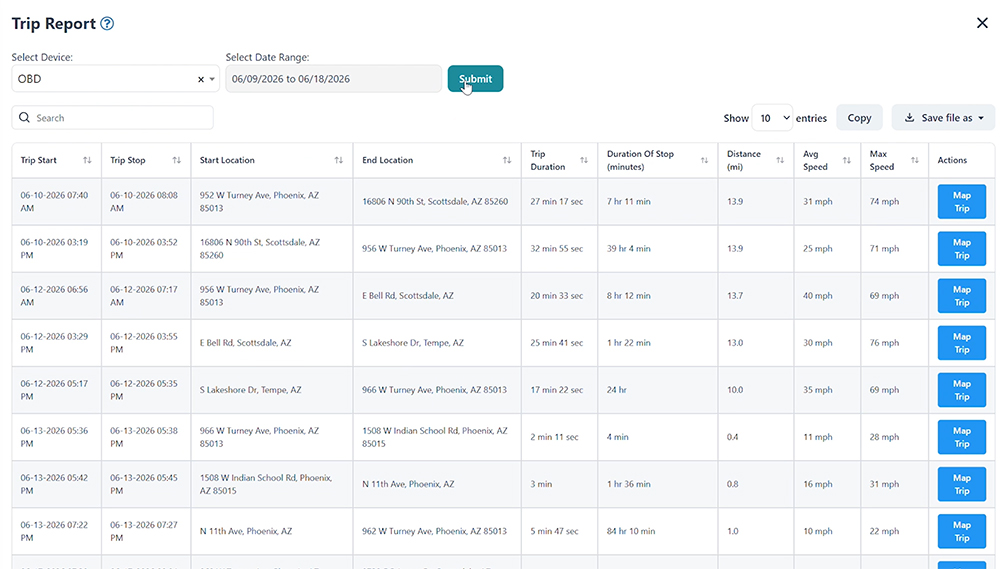
Simple Pricing, No Monthly Fees
PTO and winch monitoring is $265 per vehicle, and that includes your first year of tracking. After the first year, it’s just $99 per year. There are no monthly fees and no contracts. Catch a single unbilled job or one side job on a company truck, and the tracker can pay for itself.
Account for Every Job
Whether you run two trucks or two hundred, a single tractor or a rental yard full of equipment, in towing, construction, waste, utilities, delivery, agriculture, emergency services, or mobile services like shredding and carpet cleaning, PTO and winch monitoring gives you a clear record of when and where your equipment is working. To learn more or get your trucks set up, call 800-578-1809.